
Several times a week, power bills dominate conversations on community Facebook pages across New Zealand. Someone posts their latest electricity bill, shocked at how much higher it is than just a few years ago. Comments pour in from families struggling with unaffordable increases, desperately asking which company to switch to, only to discover they’re all equally expensive.
This isn’t just about numbers on a bill. Families are being forced to choose between keeping their homes warm and putting food on the table. When money goes to power companies instead of local shops, cafes, sports clubs and schools, entire communities suffer.
Energy must be affordable, reliable, and sustainable. Yet our communities face increasingly severe energy crises, winter after winter, while politicians treat energy policy like a football to be kicked around. Transpower warns us to reduce consumption or face blackouts. Communities endure power cuts during freezing nights. Meanwhile, the companies selling us power report huge profits.
It’s no wonder New Zealanders are losing trust in both our energy system and our political leaders.
The Commerce Commission recently set new revenue limits for Transpower and local lines companies effective from April 1, 2025, citing rising costs for materials and labour, higher interest rates, and increased infrastructure investment. The result? An average $10 monthly increase for households since April 2025, with some regions facing $25 monthly hikes.
But these immediate price rises mask a more fundamental issue: our electricity system simply isn’t designed to deliver affordable, clean, reliable power.
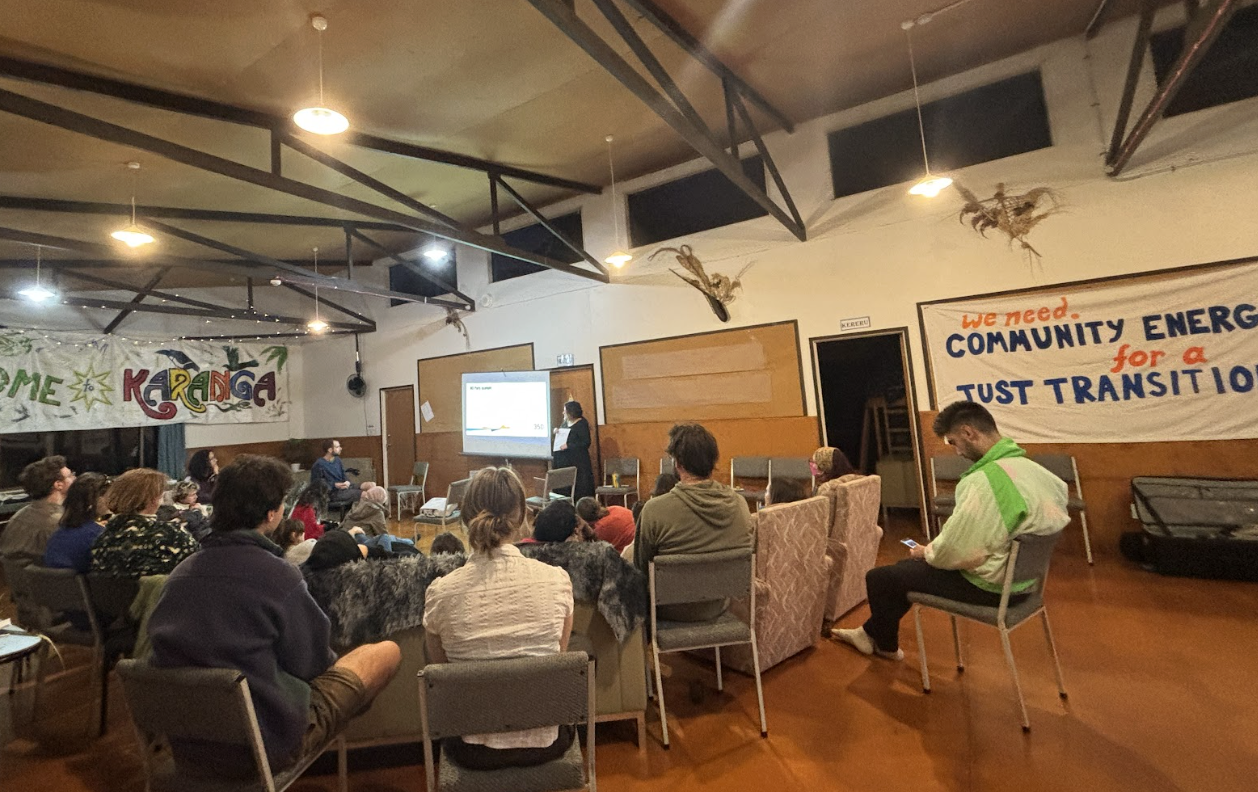
350 Aotearoa volunteers gather at their annual hui to talk energy, community and climate
The system is fundamentally flawed. When demand is high, expensive fossil fuel generators like Huntly coal plant set the wholesale price, but here’s the kicker: every generator gets paid that high price, even those producing cheap renewable energy. This means when coal is burning, the big four power companies make huge profits on their low-cost hydro and wind power. It’s actually against their financial interests to build more renewables because that would reduce these windfall profits. High emissions and high prices go hand in hand. Successive governments have commissioned electricity price reviews, then ignored their findings and recommendations
Most critically, government after government has failed to create an enduring energy transition plan. We’ve known for decades that coal and gas will become obsolete as the world grapples with the climate crisis already in motion. Reducing fossil fuel dependence isn’t just about the environment; it’s about energy security and affordability.
The previous Labour government began developing a National Energy Strategy, but this coalition government seemingly terminated that work after taking office in 2023. The current government claims a goal to double renewable energy generating capacity by 2050, but has not presented a plan to achieve it. Where is the vision to ensure New Zealand has a stable energy future?

350 Aotearoa volunteers are campaigning for an equitable energy plan for New Zealand
Electricity generation is a long game. Infrastructure projects take years to consent and build, which means we need to plan decades ahead. Yet we’ve had virtually no major renewable energy infrastructure investment in the last 10 years—leaving us nearly a whole investment cycle behind where we need to be.
The warning signs are already flashing red. Transpower’s recent Draft Security of Supply Assessment delivers a stark warning: higher risks of electricity outages starting in winter 2026, with shortages arriving four years earlier than previously forecast.
The assessment found that solar, wind and battery storage aren’t coming online fast enough to replace dwindling gas supplies. Even if every proposed electricity project in the pipeline gets built, there is reason to believe that many won’t materialise. One of the main reasons for this is the lack of certainty and incentive to build large-scale generation.
Household solar panels help, and we support every rooftop installation. But individual actions, however admirable, won’t fix system-level problems. We need large-scale renewable generation projects, and we need them fast.
New Zealand needs a comprehensive National Energy Plan; not a political document that changes with each election, but an enduring 30-year roadmap that provides certainty for investors, communities, and families.
This plan must ensure our energy supply is affordable, reliable, and sustainable. It should guide investment decisions and policy development across multiple election cycles, giving New Zealand the energy security we desperately need.
At 350 Aotearoa, we’re calling on all parliamentary parties to work together on this critical challenge. Because when the lights go out, it won’t matter which party you voted for; we’ll all be in the dark together.
—–
If you’d like to join our call to an energy energy strategy consider adding your name to our petition here.
[Nicola Campbell, 350 Aotearoa Volunteer Energy Campaigner]

Nicola Campbell—350 Aotearoa Volunteer Energy Campaigner